3 SimpleCAN
Source: SimpleCAN Manual V2 — design, program, install, maintain, and decommission Safety Simplifier and SimpleCAN networks.
3.1 Introduction
SimpleCAN is a safety communication protocol that can be used to send safety information between different Simplifier networks, and between Safety Simplifier networks and the Simplifier Gateway (to interface with, for example, Siemens/ProfiNET).
Up to 64 different SimpleCAN IDs can be used in a network, each sending 16 bits of safe data and 16 bits of unsafe data (for status and indication). This means the maximum number of safety bits that can be sent on one SimpleCAN network is 1024.
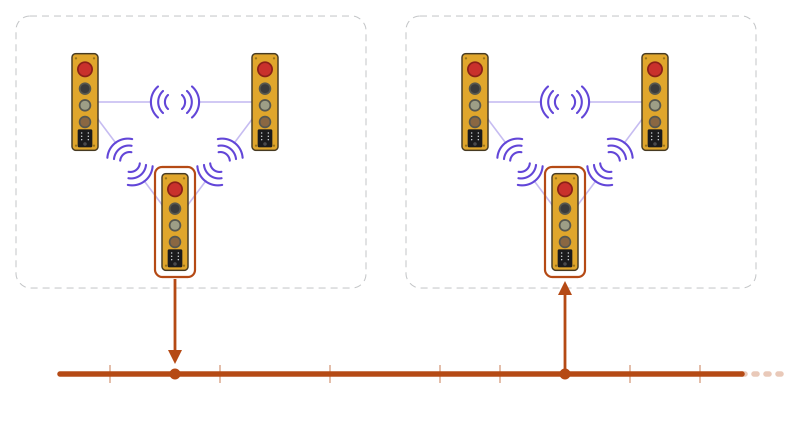
SimpleCAN between systems: one node in each radio network is connected to a shared SimpleCAN bus, which carries data between the two separate projects.
3.2 Safety notes
Warning
SimpleCAN shall only be used with the data link layer defined in ISO 11898-1 (Controller Area Network).
Warning
SimpleCAN is a protocol on top of CAN 2.0. All requirements and limitations of CAN 2.0 also apply to SimpleCAN.
Warning
The physical CAN layer shall be continuous. No repeater devices can be used to connect larger networks.
Warning
Appropriate standards shall be considered depending on the application field. In machinery and process environments, the principles defined in the common part of EN 61918 shall apply.
Warning
Only SimpleCAN compatible devices (Safety Simplifier and Simplifier Gateway) can be transmitters in a SimpleCAN network. Silent listeners are allowed to listen to the network in silent mode (according to CAN 2.0).
Contents
| Section | Topic |
|---|---|
| 3.3 PFH-d and Reaction Time | Safety values, cycle time and timeout |
| 3.4 Installation and Commissioning | CAN 2.0 cable requirements and CAN card wiring |
| 3.5 Programming and Configuration | SimpleCAN TX/RX blocks and network configuration |
| 3.6 Diagnostics and Maintenance | Troubleshooting a bus with no communication |
| 3.7 Revision History | Changes to the SimpleCAN manual |